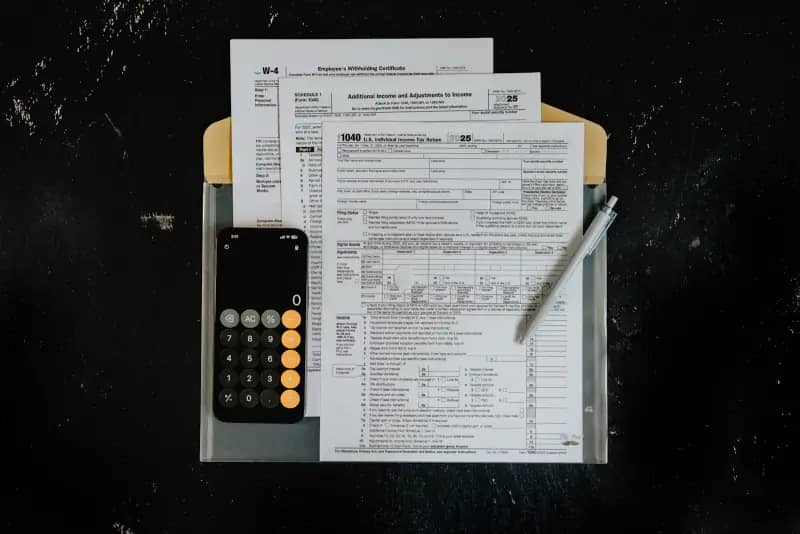


Withholding tax (Quellensteuer) is deducted from your salary each month by your employer. It applies to foreign nationals with B, G, and L permits who do not hold a C permit. The rate depends on your salary, canton, family status, and tariff code (A: single, B: married single-earner, C: married dual-earner, H: single parent). Mandatory NOV filing kicks in when gross income exceeds CHF 120000 (federal harmonization since 2021). Source: FTA — Taxes in Switzerland.
How much can you save?
AI prepares your return — an expert reviews every filing.
- All 26 cantons
- AI-detected deductions
- Expert sign-off before filing
What is Swiss withholding tax?
Withholding tax (German: Quellensteuer; French: impôt à la source; Italian: imposta alla fonte) is Switzerland's method of collecting income tax from foreign workers at the source — directly from the employer.
Each month, your employer deducts a tax amount from your gross salary and remits it to the cantonal tax authority on your behalf. This replaces the standard annual tax return process for most foreign workers earning below CHF 120000.
Who is subject to withholding tax?
| Permit | Subject to withholding tax? |
|---|---|
| B permit (residence) | Yes |
| A permit (short-term) | Yes |
| G permit (cross-border) | Yes |
| L permit (short-term) | Yes |
| C permit (settlement) | No — ordinary assessment |
| Swiss citizen | No — ordinary assessment |
Since 2021: Persons without a C permit who are married to a Swiss citizen or C permit holder and live in the same household are no longer automatically subject to withholding tax — they now follow ordinary assessment.
Tariff codes — how your rate is determined
Every withholding tax payer is assigned a tariff code by the cantonal tax authority. The code determines the applicable tax rate table.
| Code | Family situation | Details |
|---|---|---|
| A | Single, no children | Standard single rate |
| B | Married, one income | Married rate (splitting benefit) |
| C | Married, two incomes | Both partners work — taxed individually at higher rate |
| H | Single parent | One parent with children in same household (Konkubinat) |
| D | Supplementary income | Second income for married couples |
| P | Pension recipients | Applies to foreign pension income |
Important — Code A vs Code C:
- Code A is for genuinely single people.
- Code C applies to married B permit holders whose spouse also works — this code results in a higher withholding rate, but is often more accurate and avoids a large underpayment on the NOV.
Check your payslip now. If the code is wrong, contact your cantonal tax authority immediately — wrong codes cannot always be corrected retroactively.
Withholding tax rates 2025 — Canton Zurich examples
Rates are updated annually on January 1 and vary by canton.
Canton Zurich — Code A (single, no children)
| Gross monthly salary | Gross annual salary | Approx. monthly withholding |
|---|---|---|
| CHF 4,000 | CHF 48,000 | CHF 448 (11.2%) |
| CHF 6,000 | CHF 72,000 | CHF 840 (14.0%) |
| CHF 8,000 | CHF 96,000 | CHF 1,248 (15.6%) |
| CHF 10,000 | CHF 120000 | CHF 1,700 (17.0%) |
Canton Zurich — Code B (married, one income, no children)
| Gross monthly salary | Approx. monthly withholding |
|---|---|
| CHF 6,000 | CHF 504 (8.4%) |
| CHF 8,000 | CHF 752 (9.4%) |
| CHF 10,000 | CHF 1,050 (10.5%) |
Indicative figures. Actual rates from ESTV withholding tax tables.
Withholding tax vs. ordinary assessment — key differences
| Withholding tax | Ordinary assessment (NOV) | |
|---|---|---|
| Who deducts | Employer, monthly | You declare — pay after assessment |
| Deductions claimed | None (formula-based) | All individual deductions |
| Filing required | Only if mandatory NOV | Full tax return required |
| Final settlement | Usually final (if <CHF 120k) | After assessment notice |
| Refund possible | Via NOV only | Yes, if overpaid |
When is withholding tax NOT final?
Withholding tax is generally considered the final tax settlement for B/G/L/A permit holders earning under CHF 120000. However, you must (or should) file a NOV if:
Mandatory NOV:
- Gross income exceeds CHF 120000 per year (B permit) — since January 1, 2021
Voluntary NOV (recommended):
- You have significant Pillar 3a contributions (up to CHF 7258 deductible)
- You paid mortgage interest on Swiss property
- You have high professional expenses
- You have childcare costs above the formula allowance
- You have foreign income or assets to declare
Requesting a voluntary NOV (B permit)
To voluntarily opt into ordinary assessment, you must submit a written request to your cantonal tax authority before March 31 of the year following the tax year.
Example: For tax year 2025, the request deadline is March 31, 2026 in most cantons.
The request is binding — you cannot withdraw it once submitted. Once you have requested the NOV for one year, you can decide each subsequent year independently.
Withholding tax on special income
Annual bonus
If you receive an annual bonus, the withholding tax rate is recalculated using the annualized method — the bonus is projected over 12 months to determine the applicable rate. This often results in a higher effective rate for the bonus month.
RSUs and stock options
RSU income at vesting is subject to withholding tax. The market value of shares at vesting is added to your gross income for that month and taxed at source. If this pushes annual income over CHF 120000, mandatory NOV applies.
→ RSU taxation guide Switzerland
13th month salary
Switzerland commonly pays a 13th monthly salary. This is treated as regular income and subject to withholding tax in the month of payment.
This guide does not replace individual tax advice. All information is provided without guarantee.
Frequently Asked Questions
Yes, if you file a voluntary or mandatory NOV and your actual tax liability (with all deductions) is lower than the withholding tax already paid, the difference is refunded. Typical refund scenarios include Pillar 3a contributions, mortgage interest, and childcare costs that were not reflected in the withholding calculation.
Your tariff code appears on your monthly payslip (Lohnabrechnung). Compare it against your family situation. If you believe the code is wrong, contact your cantonal tax authority — not your employer. The employer only applies the code assigned by the tax authority.
If your employer failed to deduct withholding tax, you remain personally liable for the tax. Contact the cantonal tax authority proactively — late payment interest applies from the original due date.
Yes — withholding tax covers federal direct tax, cantonal tax, and communal tax simultaneously. It replaces the ordinary assessment process for qualifying permit holders below the CHF 120000 threshold.
Yes. Once you submit a voluntary NOV request to the cantonal tax authority, you cannot withdraw it for that tax year. However, you can decide independently each subsequent year whether to request the NOV again.
- expats
- steuern
- kantone